Description
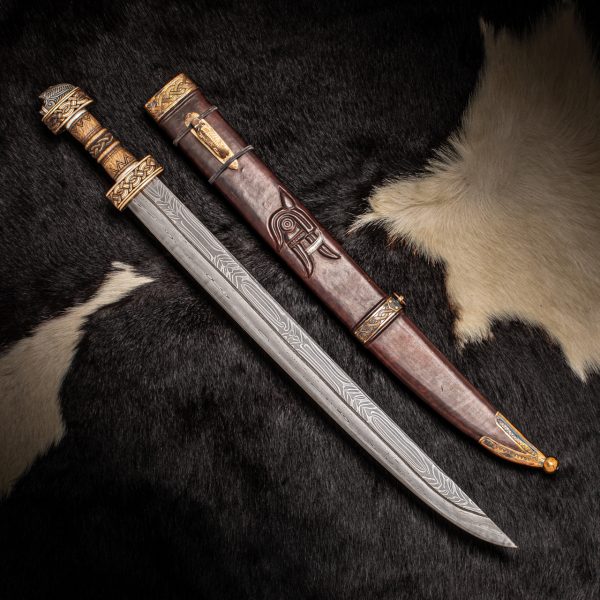
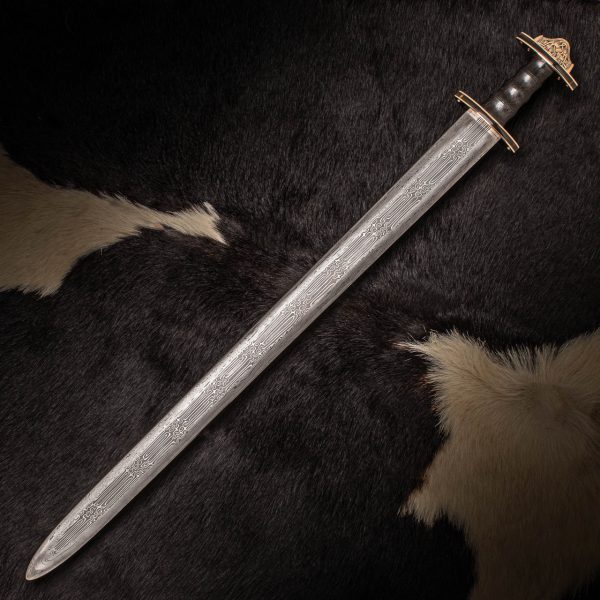
“Jet” an Illerup Idal inspired Pattern welded Spatha with Iron and Keum boo Gold fittings.
Jet is a lenticular bladed Patternwelded Spatha.
It is inspired by swords I saw when visiting Northern Germany and Demmark. There are a couple of collections of blades particularly the ones from Illerup Adal in Demmark that are on show at the Moesgaard Museum in Denmark. Some of these blades Have the most complicated patternwelding I have ever seen in historical or modern pieces they were made around 200AD.
The blade is lenticular section and 26″ long.
Making the blade was quite an undertaking and I can honestly say its is among the most complex piece of patternwelding I have undertaken to date. I undertook the patternwelding of this blade with the American Bladesmith Salem Straub based in Washington State. I was lucky enough this year to embark on a QEST (Queen Elisabeth Trust) learning grant year. So I have been training myself to learn different technical aspects of the craft. As part of that training I spent 2 weeks with Salem Straub. Salem is a patternwelding wizard , and has a style that is very diferent from my work. I was very eager to spend some time with him and make a couple of blades and explore some different methods to construct blades based on the finds I had seen in Denmark.
I had an amazing time Patternwelding with Salem, we attempted some techniques that were new to us both and it was very informative to me working in such a meticulous way. It was challenging work and being meticulous is really the only way approach a project of this type.
The blade has Palmate , wheat sheaf emblems along the blade there are pin striped pieces separating the palmates. There is a twisted bar up the middle of the blade that terminates in a spiral near the tip. The core elements are surrounded by a high layer edge wrap. and there is a steel wedge to separate the palmates at the hilt. The whole blade was constructed as separate individual elements, each made from many pieces forged and ground to size and then carefully assembled, a bit like Metal marquetry…then the whole thing was Forge welded together very carefully!!!
I then brought the billet back to my forge in the UK and forged the blade billet to shape .
In October of this year I went on an artists retreat in Northumbria with my friends James wood, and Petr Florianek. (both amazing smiths in their own right) .We were lucky enough to find some Whitby Jet on the sea shore. The Jet is a type of fossilised coal, 180 million years old from the Araucaria tree ( an ancient relative of the monkey puzzle tree ). It polishes up amazingly and was used to make Jewellry in the iron age and also in Victorian times. The jet used in the guard of this sword has been stabilised with resin.
I wanted to incorporate some of the Jet we found into this sword. That where the sword gets its name from .
The pommel cap is deeply etched and engraved Wrought iron .It has been accented with 24ct gold Keum boo .The upper and lower guard are made from blackened vintage wrought iron which has been heavily etched, the wrought iron has been accented with pure 24ct gold using the Kuem boo method, where gold is joined to the iron by hot burnishing this joins the gold and iron at an atomic level. I really like the Keum boo method , its a great way to get gold to the piece and has a wonderful textures element from the wrought iron. I have applied the keumboo to look worn and to allow some of the wrought iron to show through. Its another technique I learned in the last year and I will be using it more and more. Its known as a korean technique but has been used in Europe throughout antiquity.
the handle is carved from stabilised Bog oak from East Anglia.
I would be happy to make a royal scabbard for this sword , please enquire.